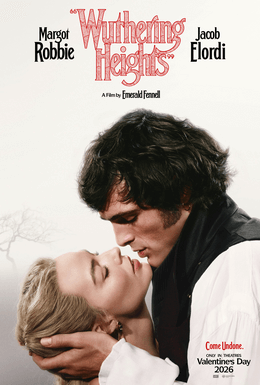
Social media is abuzz with criticism for the upcoming adaptation, saying Emerald Fennell isn’t taking the book seriously. Are they right? Or this is an instance of premature outrage?
The response to the “Wuthering Heights” trailer reeks of fatigue. Audiences are tired of seeing the same actors in every new release and tired of being served adaptations that don’t live up to the greatness of the source material. Emerald Fennell and her team’s insistence on Jacob Elordi as a leading man is causing many moviegoers, Brontë lovers, and the chronically online a mess of grief.
While I’m not a huge fan of the movie’s casting, I remember quite clearly the angry mob of keyboard warriors who prematurely came after Heath Ledger as the Joker, Daniel Craig as James Bond, and Renee Zellweger as Bridget Jones.
If you didn’t live through it, you wouldn’t have believed the backlash Craig received as a blonde Bond. That incontinuity with Ian Fleming’s slick, black-haired spy welcomed additional, usually petty, criticism about Craig’s short stature and his potential inability to perform stunts.
Well, many of those casual critics were forced to eat their words. Craig was so successful at bringing Bond’s vulnerability to the screen that he took on the role of 007 in five different films. I would venture to guess that most people, if you asked them now, would consider him the quintessential Bond.
Similarly, Zellweger impressed as Bridget Jones, playing her four times over a nearly 25-year period. And for his brilliant and deeply unsettling betrayal of Batman’s archnemesis, Ledger posthumously won an Oscar.
Will we find ourselves backtracking our barbs at Elordi?

Detractors will say that this situation is different. Elordi’s casting deliberately ignores a critical plot point: Heathcliff is a person of color.
I must preface this by saying I am no fan of whitewashing. I haven’t forgotten or forgiven Emma Stone’s casting in Aloha. I found Scarlett Johannssen’s role in Ghost in the Shell heinous.
And it’s particularly egregious when a character’s ethnic or racial background is central to the story. However, the social media fault-finding with casting a “white man” to play Heathcliff is, in my view, somewhat lazy. Not because of the whitewashing, which I agree is a painful affront to the character, but because viewing this casting through race alone overlooks the depth of Heathcliff’s otherness.
The calls for Dev Patel specifically are especially frustrating to me, and their frequency supports how short-sighted we can be as Americans when it comes to race, ethnicity, and nationality. Our demand for this actor in particular highlights our incapacity for nuance, which was exactly Brontë’s intention.

Yet, many online critics are furious about Eldori’s casting, to the point where I’m beginning to think some people have developed an unhealthy parasocial relationship to the novel’s tragic antihero. Insisting that there is only one true way in which Heathcliff can be “othered” completely misses the point.
Depending on your edition, the novel implies Heathcliff’s mysterious ancestry in several different ways: as a “gipsy brat,” a little Lascar (a term for Indian or southeast Asian sailors)”, “dark-skinned,” and “a Spanish castaway.” In one passage, where Heathcliff is imagining how much better his life would be if he were fair-haired and blue-eyed, Nelly, one of the more rational characters despite her prejudice toward him, encourages that he craft an even better impression, as if his “father was Emperor of China” and his mother were “an Indian queen.”
These inconsistent labels aren’t malignant attempts at a singular identification. In fact, many scholars insist that this deliberate refusal to confirm Heathcliff’s lineage is what’s central to his role as an outsider. It doesn’t really matter what Heathcliff is. What matters is that he’s different. He has no status, no position, no religion, and no wealth. He is a foreigner in every way possible, the perfect canvas on which to project the deepest anxieties of imperialist Victorian society.
Terry Eagleton, one of the most cited literary critics of the past 50 years when it comes to Wuthering Heights, proposes that Heathcliff may be Irish. I think he makes a strong case for this. The Irish Famine was raging at the time of the book’s publication, and it’s well-documented that Branwell Bronte took a trip there in 1845, right at around the time his sister Emily began her novel. By 1847, hundreds of thousands of displaced Irish had made their ways to Liverpool, where Heathcliff is found.
But, Eagleton also feels like white actors can play black characters, just as black actors can play white ones.
At any rate, for many scholars, the race ambiguity is only a part of what makes Heathcliff so captivating. Feminist interpretations would see him as a symbol of reckless freedom for Cathy (while Edgar represents a more patriarchal rigidity). Others, would see him as a fetishization object. There are many interpretations. Eagleton has written about Heathcliff representing the famine itself, his hunger for revenge a reflection of the Irish.
I’m sure this is not the intention, but by having racial otherness as the only focus, we’re equating race exclusively with the additional ways in which Heathcliff is othered: by his lack of pedigree and status. Worse still, by his violence and abuse.
And that’s where we get into tricky territory for Hollywood: reinforcing certain stereotypes by casting a person of color as ruthless, wild, and cruel.
When Denzel Washington won an Oscar for his role in Training Day, the Washington Post eviscerated the Academy for rewarding black actors only when they fulfilled certain roles, usually those marked by aggression, criminality, or trauma. Bell Hooks has also written critically about Hollywood’s tendency to represent black women through the lens of servility or malice.
Just as I’m making this argument now against race as a sole basis for Heathcliff’s otherness, I would expect a similarly critical reaction if Heathcliff were made a POC. In fact, it’s already happened.
In 2011, James Howson took up the role of Heathcliff in Andrea Arnold’s adaptation of Wuthering Heights. Initially, Arnold sought a Romani actor, aligning with Heathcliff’s most accepted lineage (he is referred to as a gypsy several times throughout the novel). Unsuccessful, she plucked Howson, an unknown, to play her Heathcliff. Her version is recognized for casting age-appropriate actors (another point of contention to Fennel’s version is that Margot Robbie is nearly twice book Cathy’s age), and also for its racially charged portrayal of Heathcliff, who is poorly treated and whipped.
American critics were quick to provide their reactions. David Denby wrote in The New Yorker that attitudes toward this Heathcliff were “bigoted,” adding “an element of racial consciousness that wasn’t Brontë’s concern.” Slate made mention of Arnold’s use of the n-word to disparage Heathcliff, saying this adaptation was “more explicitly racial” than Brontë’s novel. Sadly, Howson’s performance was deemed emotionless, and the pace of the film lethargic, so any positive feelings toward the movie were drowned out by disappointing reviews.
So, I guess one could say, “been there, done that.”
And right now, you’re probably thinking. Okay, well, this is a stretch.
Maybe. But when I see countless women on social media comment things like, “Dev Patel was right there,” ad nauseam, I can only conclude that 1) Americans have a very limited knowledge of tan-colored Englishmen and 2) just like Cathy, we are sexually attracted to this otherness.
Of course, Cathy also felt like an outcast, so she embraced Heathcliff as more than her equal, but as a part of her (“I am Heathcliff”). But she also acknowledged that marrying him, a man of low and untraceable birth, would “degrade” her. She’s attracted to him, surely, but she understands she must reject him to maintain who she wants to be.
And that’s where the fetishization comes in. Heathcliff is framed as exotic, hyper-sexual, and fascinating, while at the same time, he is derided as dangerous, savage, and immoral. Heathcliff represents this distinction fully, not simply by race or ethnicity alone.
It is important to note that the literary Brontë family was faithful and supportive of their Christian upbringing. After all, Anne, Charlotte, and Emily were raised by an Anglican minister. While Emily’s poetry is usually viewed as favorable of Christianity, it is, however, widely accepted that she rejected its more Orthodox teachings.

Regardless of her personal feelings, Brontë lived in a society in which religious otherness represented a spiritual risk. Heathcliff is referred to as a “devil” and an “imp of Satan” to reinforce his status as an unbaptized threat. Throughout the novel, he rejects Christian faith in his pursuit of his revenge, and most notably, his exhumation of Catherine (which would have been appalling to a Victorian Christian audience). In fact, the book was panned by contemporary critics for being ghoulish and “unnatural.”
Now, I’m going down a rabbit hole, maybe, but my point is: Heathcliff’s otherness is multi-faceted and much more complicated than looking at the color of his skin alone. His alien nature, with its inconclusive definition, destabilizes every facet of what’s considered acceptable in his new home. This is far more poignant and piteous. For everything he is, not just the way he looks, Heathcliff is despised.
As Americans, race is so supercharged with meaning. Like or not, our media internalizes racial otherness as a demonstration of a comprehensive unknown: of danger, corruption, lasciviousness, lower status, and submission.
Which is why I take so much offense to presuming (because yes, it isn’t out yet) Fennel’s version would be improved if only Heathcliff were darker.
I admit, it’s been a very long time since I first read Wuthering Heights. I read it half my lifetime ago, in college. Being 19 and only naively aware of the novel’s premise, I too, viewed Heathcliff’s difference as mainly one of race. Brontë wrote the novel at the height of the British Empire and in the midst of the transatlantic slave trade. Earnshaw brings him home after a trip to Liverpool, a major port city associated with colonial trade routes and the slavery that supported such commerce. How could his ambiguous parentage be seen in any other way than that of color and colonial oppression?
However, that’s only a small part of what makes Heathcliff such a dominating figure. He is psychologically complex, morally ambiguous, and heretically passionate. All characteristics of the “other,” not just the “other race.”
This biblical need for Dev Patel aside, I’ve also been surprised to see so many recriminations about Fennel’s approach. The salacious beginnings of the movie, which purportedly involve a nun fondling an erect corpse, have received just as much backlash as the whitewashing.
For those trying to apply a veil of purity to the movie as a means to remain faithful to the story, you’re ignoring another well-researched interpretation. There are several scholars who view Catherine and Heathcliff’s relationship through a lens of sado-masochistic power dynamics. Their suffering, which they inflict upon each other with pleasure and in different ways, is eroticized. Heathcliff begs to be hurt by Catherine, and she has a strong desire to possess and dominate him. Even Eagleton, who has been writing about Wuthering Heights for decades, sees Heathcliff as a “sado-masochistic wretch.”
Bronte published the book initially under an androgynous pseudonym, Ellis Bell, fearing the work wouldn’t be taken seriously if it were known she were a woman. Her sisters did the same for their publications. And when the book was published, its reception was mixed. While many critics found the novel powerfully imaginative, others found it improbable and “morally tainted,” full of “vulgar depravity and unnatural horrors.”

And look at where we are now. A woman, Emerald Fennel, is receiving criticism for going too far and not remaining faithful to what I presume people think is a more virtuous and ethical romantic novel. Would we be doing the same thing if it were adapted by Quentin Tarantino? Well, maybe, but I think for different reasons.
All that is to say, I watched the trailer, and honestly, I found it sexy. Maybe I’m easy to please in that regard. But I also have zero expectations that the movie follows the book word-for-word. Like Heathcliff’s character and motivation, there should be more depth to an adaptation than simply being a literal copy.
For all those critics saying Brontë would be rolling in her grave, I actually think she might be quite pleased with Fennel’s ambitions to produce a visceral reaction, whether it’s lustful, depraved, or indecent. Because, whether she intended to or not, that kind of scandal is exactly what she generated. And it’s important to recognize that, as that kind of shock is what has allowed the story to endure.
Leave a Reply